


Working with a paint color consultant is normally a separate designer fee. With us it is free, it lasts a full hour, it happens in your own home before you have agreed to any work at all, and you keep the colour codes whatever you decide afterwards.
The reason we include it is straightforward. The most expensive mistake in a painting job is choosing a colour you end up disliking, because fixing it means paying for the whole job again. An hour spent on light, undertone and sheen is the cheapest insurance in the process.
What your free paint color consultant hour includes
- A trained colour designer at your property for a full hour
- Booked alongside your free estimate, so it is one appointment rather than two
- Your light assessed at the time of day you actually use the room
- Work built around the fixed finishes you are keeping
- Hundreds of options narrowed to a small number worth testing
- A sheen recommendation for every surface, not just a colour
- Specific Sherwin-Williams or Benjamin Moore colour codes, written down
- The codes are yours whatever you decide afterwards
- The record kept against your address for future touch-ups
Our colour consultation process
Book it with your estimate
The hour is scheduled alongside the free estimate, so you are not making two appointments.
Walk the space
The designer looks at the rooms at the time of day you actually use them, because light changes everything.
Work outward from what stays
Floors, worktops, tile and fixtures set the constraints, because their undertones are fixed and the wall colour is not. The designer reads those undertones first and chooses wall colours that sit with them.
Narrow, then test
Hundreds of options come down to a handful worth sampling on your actual walls, so the decision is made against your light rather than a showroom’s.
Record it
You leave with specific colour codes and a sheen per surface, written down.
Why paint colour goes wrong so often
Light
Western Slope light is bright and warm, and the UV index here is high. It pushes cool greys towards blue and can make a warm white read distinctly yellow. The same colour behaves differently on a north wall and a south wall in the same room.
Scale
A colour on a two-inch chip and the same colour across an entire wall are not the same experience. Saturation reads much stronger at scale, which is why so many people find their new walls “louder” than expected.
Everything already in the room
Your floors, worktops, tile, cabinets and fixed finishes all have undertones. A grey that fights the undertone in your flooring will look wrong forever, and you will never quite be able to say why.
Yes, included with every estimate, with no obligation to book any work afterwards. We include it because it removes a real barrier. People delay painting for months because they cannot decide on colour, and a designer hour solves that far faster than another weekend of paint chips on the kitchen table.
Testing before you commit
- Test on your actual walls, not on a chip held against them
- Two coats, so the sample reads at full strength
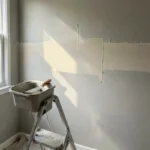
- A patch at least two feet square
- Painted on more than one wall in the room
- Looked at in the morning
- Looked at in the middle of the day
- Looked at under your own lamps in the evening
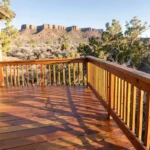
For an exterior, do the same thing on the shaded and the sunlit elevation, because the same body colour can look two shades apart across one corner of the house.
Paint and finishes we specify
Sherwin-Williams and Benjamin Moore throughout.
Washable matt for the softest look, eggshell where the walls get touched.
Eggshell, because it takes a wipe-down without polishing up a shiny patch.
Satin or semi-gloss enamel, which levels out brush marks as it cures.
Flat, so downlights do not pick out every imperfection.
Scrubbable acrylic in satin, for rooms that see steam and cleaners.
Satin or low-lustre, chosen for UV and colour retention as well as shade.
Sheen and colour interact, which is why the designer recommends both. The same colour in matt and in satin reads as two different colours on the same wall, because a higher sheen reflects more light back and lifts the apparent value of the shade.
What happens after the consultation
You are under no obligation at all. Some people book the work that week, some take the colour codes away and think about it for a month, and some use the codes to paint it themselves. All three are fine.
- Deep exterior colours fade faster. There is more pigment to break down under our UV load, so a dark exterior is worth pairing with a product line that has better colour retention.
- Very dark exterior colours absorb heat. That increases the daily expansion and contraction on that wall, which is worth factoring in on stucco especially.
- Interiors are unconstrained. None of the UV load applies inside, so you can choose freely.
- HOA schemes are worked from the inside. The consultant works within those constraints and documents the approved codes so future maintenance matches.
- Rental and managed property gets a written record. We keep the exact product, code and sheen used, so a unit repainted in three years matches the one next door.
If you do go ahead, the codes go straight onto the job sheet so there is no confusion between what you chose and what gets ordered. We also record them against your address, so if you call us in four years to repaint one room, we already know exactly what is on the walls. With the brand, the colour code and the sheen written down, a touch-up years later is a trip to the paint store. Without it, matching means taking a sample in to be read, and even a good read cannot recover the sheen you originally chose. Book yours with a free estimate.
Talk to Us About Your Painting Project

Common questions
Is it really free?
Yes, a full hour, included with your free estimate. No obligation.
Is it a real designer?
Yes, a trained colour designer who works in colour and sheen every day.
Can I get sample pots?
Yes, and we recommend testing on your actual walls before you commit.
What if I change my mind later?
Colours are locked at the start of the work, not at the consultation, so you have the whole gap between the estimate and the start date to live with the samples.
Can you match an existing colour?
Yes, including matching existing trim, an island, or a neighbouring room. If there is no record of the original, we can take a sample and have it read on a spectrophotometer at the paint store.
Do you help with exterior schemes?
Yes, including working around brick, stone and roof colour you are not changing, and splitting the scheme into body, trim and accent so the front door can carry the colour rather than the whole house.
How many colours should a house use?
Most interiors work on one wall colour running through the shared spaces, one trim colour throughout, and one or two rooms doing something different. Most exteriors work on three: body, trim and accent.
Can you help if we are selling?
Yes. The brief is different when the aim is broad appeal rather than personal taste, and the designer will say which of your options is the safer choice for a sale.
Where we do this work
Across Grand Junction and Mesa County, and out to Montrose. Same pricing, same crews, same nine-year written guarantee wherever you are.