

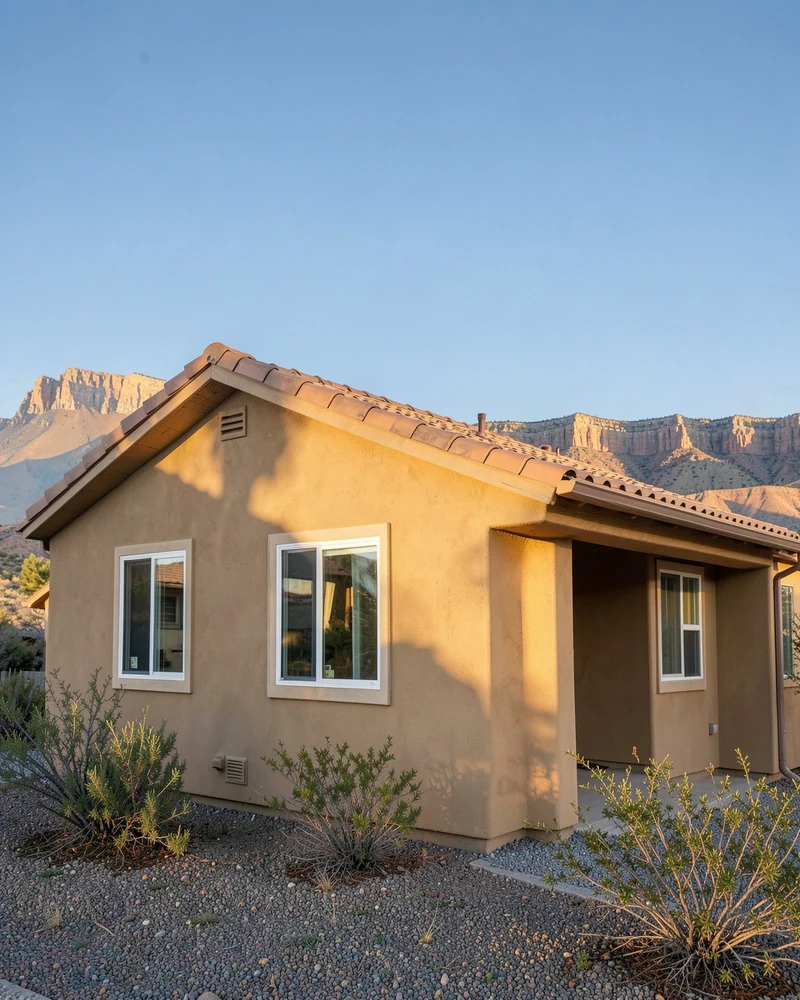
Stucco repair in Grand Junction is a maintenance item, not an emergency, and treating it that way is what saves money. Every winter the freeze-thaw cycle opens a few more hairline cracks, and sealed at the next recoat they cost very little. Left for several seasons, water works its way behind the render, and then the repair is to the wall behind the stucco rather than to the stucco itself.
We have been patching, texturing and coating stucco here since 2011. The estimate is free, it sets out the crack work and the coating separately, and the workmanship carries a nine-year written guarantee.
What every stucco job includes
- A free on-site assessment, walked elevation by elevation, with crack widths noted
- Crack pattern read for thermal movement, settlement or delamination, and told to you plainly
- Hairline cracks opened to a V so the filler has something to key into
- Loose and hollow material cut back to sound stucco
- Repair mix matched to the existing render
- Texture matched by hand or by hopper, tested on a board first
- Full cure time before any coating goes on
- A breathable or elastomeric masonry coating from Sherwin-Williams or Benjamin Moore
- Written product, colour code and texture record for your address
- A final walkthrough with you before any payment is due
- A nine-year written workmanship guarantee
How our stucco repair process works
Assessment
We read crack pattern and width, sound the wall for hollow areas, and check the existing coating for blistering. Width and direction tell us whether we are dealing with normal thermal movement, settlement, or a coating problem, and you get that answer before you get a price.
Open and clean
Hairline cracks get widened slightly to a V so filler has something to key into. Loose and hollow material is removed back to sound stucco, and the edges are undercut so the patch is thicker at its perimeter rather than feathered thin.
Patch with a compatible material
Repair mix matched to the existing render, in lifts rather than one thick fill on deeper areas. Compatibility matters because a patch that is harder or stiffer than the wall around it moves at a different rate and re-cracks within a season. Where the stucco has come away from the lath, new lath and a scratch coat go in first.
Texture match
This is what decides whether the repair reads as part of the wall or as a patch. Dash, sand float, lace, skip trowel and knockdown all get matched to what is there, and we test the mix and the throw on a board before touching the wall.
Cure, then coat
Cementitious repairs need to cure and dry before they are coated, typically several days and longer in cool weather. Coating too early traps moisture in the patch and shows as a shade difference later, so the cure time is built into the schedule.
Breathable coating
An elastomeric or breathable masonry coating that bridges hairlines and still lets the wall release moisture, applied at the manufacturer’s specified film thickness rather than thinned out to cover more wall.
Catching stucco problems early
Hairline cracks under a sixteenth of an inch
Normal thermal movement. Note them, seal them at the next recoat, no urgency.
Cracks wider than that, or growing
Worth a look now, because water is getting in.
Diagonal cracks from window and door corners
Settlement. Needs sealing, and you should know the cause is the building rather than the render.
Hollow sound when you tap it
The stucco has delaminated from the lath behind. This is the one that needs attention rather than monitoring.
Bubbling, blistering or sheeting coating
Almost always a previous non-breathable coating trapping moisture. It will keep coming off until it is properly stripped and recoated with something breathable.
The practical version: plan a look at the walls each spring, seal the hairlines at the next recoat, and the cycle costs you a coating rather than a rebuild.
Stucco in older Grand Junction homes
- Older render is often softer than a modern mix
- Sand and cement ratios varied from batch to batch
- Most walls carry two or three generations of patching, each with a slightly different texture
- Matching a 1970s sand float takes longer than matching a modern knockdown
- Older walls tend to have metal lath rather than a modern paper-backed system
- Lath that has rusted where water sat behind the render is replaced before the patch goes on
One more thing worth knowing on an older home: the original stucco often sits directly over board sheathing with no drainage plane behind it, so keeping water out of the cracks matters more than it does on a newer build. That is the whole argument for sealing hairlines at each recoat rather than leaving them.
Materials and technique
Breathable masonry coatings and elastomeric systems from Sherwin-Williams and Benjamin Moore, chosen for crack bridging and vapour permeability as well as colour.
Elastomeric coatings stretch with the daily movement instead of tearing at the joints, which is the property that counts on a Western Slope wall.
Elastomerics are specified by film thickness, applied in two coats, and back-rolled or brushed into the texture so the coating fills the profile rather than sitting on its peaks.
Where a wall is in sound condition and you want a lighter build, a high-permeability acrylic masonry coating is the alternative.
Matched to the existing render, applied in lifts rather than one thick fill on deeper areas.
Dash, sand float, lace, skip trowel and knockdown all matched to what is there, tested on a board before the wall is touched.
Standard exterior house paint is not the right product class for stucco, because its permeability is too low to let the wall dry outwards.
UV degrades the coating surface, and the daily thermal cycle works the substrate continuously. Most stucco on the Western Slope needs recoating every five to ten years, and south and west elevations sit at the shorter end of that range. You can check the local UV index and see why.
What stucco repair in Grand Junction costs
Priced on the amount of crack work, the difficulty of the texture, and how much coating the elevation needs. What moves your number:
- Linear feet of cracking. Counted, not estimated by eye, and split between hairline and wider than a sixteenth of an inch.
- Area of hollow or delaminated stucco. Anything that has to come back to lath is a bigger job than a surface fill.
- Texture complexity. A modern knockdown is quicker to match than a 1970s sand float or a hand-applied lace.
- Whether the elevation needs recoating. A patch on a coated wall can show as a shade difference, so a full-elevation recoat is often the tidier answer.
- Access. Two-storey walls, steep ground and mature planting all add staging time.
- Existing coating condition. A wall with a low-permeability film blistering off needs that film removed before anything else happens.
We walk you through exactly which of those applied to your estimate.
Talk to Us About Your Painting Project

Common questions
Can you match my texture?
Yes. Dash, sand float, lace, skip trowel and knockdown. We mix and test on a board first, then match the throw and the density on the wall.
Do I need to recoat the whole wall?
Not always. On a wall with an even, sound coating a patch can blend. On a faded elevation the patch will read as a different shade, and we will say so at the estimate so you can decide.
How long before it can be painted?
Repairs need to cure and dry, usually several days and longer in cool weather. You get the timeline upfront.
Is stucco work covered by the guarantee?
Yes, nine years in writing on our workmanship.
Can you install new stucco?
Yes, as well as repair and recoating, including lath and scratch coat where a section has come away.
What if the crack is structural?
We tell you at the assessment, and we say what we would seal and what is worth a structural opinion first.
Can you do this in winter?
Patching and coating both have minimum temperatures, so most stucco work runs spring through autumn. We watch overnight lows as well as daytime highs.
Where we do this work
Across Grand Junction and Mesa County, and out to Montrose. Same pricing, same crews, same nine-year written guarantee wherever you are.