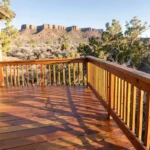


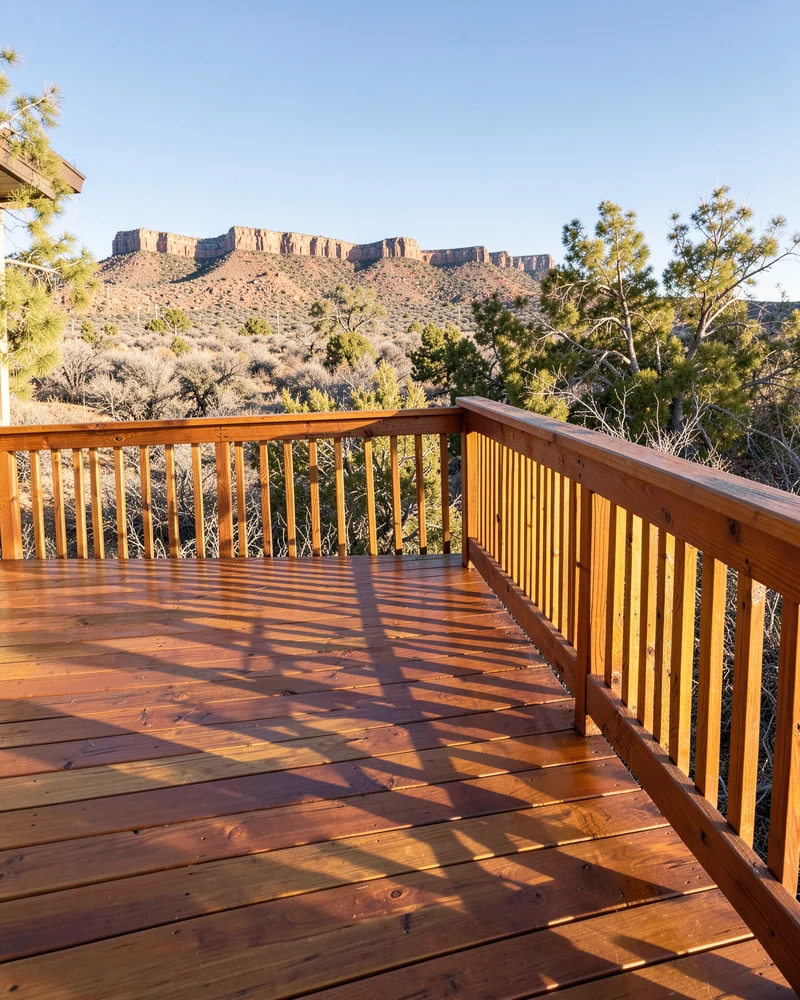
Deck staining in Grand Junction lives or dies on timing. Stain works by soaking into the timber, and three local conditions decide whether it can: how much moisture the wood is still holding, how hot the boards are when the stain goes on, and how cold it gets that night. Get all three right and the same product lasts years longer than it would applied on the wrong afternoon.
We have been staining decks, fences and pergolas here since 2011. The estimate is free, and the workmanship carries a nine-year written guarantee.
What every deck job includes
- A free on-site assessment, with board condition and railing count noted
- Failing or peeling old stain stripped back, sound stain cleaned and recoated
- A wood cleaner to lift dirt and greying, then a brightener to open the grain
- Dry-down to the right moisture content before any stain is applied
- Sanding of raised grain and rough spots, especially on handrails
- Popped nails and screws reset, split or rotted boards flagged with a price
- Penetrating oil or hybrid stain from Sherwin-Williams or Benjamin Moore
- Back-brushed into the grain, including the end grain at every board end
- Planting and siding masked, and the timing planned around temperature
- A final walkthrough with you before any payment is due
- A nine-year written workmanship guarantee
How our staining process works
Assess the timber
Age, species, current coating, and whether it is sound. Boards that are splitting or rotten get flagged before we quote a finish on top of them.
Strip if needed
If the previous stain is failing or peeling, it has to come off. Staining over failing stain just re-peels along the same lines.
Clean and brighten
A wood cleaner to lift dirt, mildew and the grey surface layer, then an oxalic acid brightener to neutralise the cleaner and reopen the grain. The brightener is what lets stain absorb evenly across boards that have weathered at different rates.
Dry down
We wait for the timber to reach the right moisture content, usually two to three days after washing in warm dry weather and longer in cool or shaded conditions. Stain cannot penetrate wood that is still holding water, so the wait is part of the specification.
Sand where needed
Raised grain, splinters and rough patches knocked back, especially on handrails and steps where people put their hands. Popped nails and screws get reset first.
Apply in the right window
Out of direct sun, on boards below the product’s maximum surface temperature, with overnight lows above its minimum. Back-brushed into the grain, and worked into the end grain at every board end, because end grain is where water enters fastest.
Walk it with you
Same as every job. You approve it, then you pay, and we give you the product and colour code for the next recoat.
Why timing decides everything
Wood moisture
Freshly washed or recently rained-on decking needs to dry down before staining. Days, not hours, depending on conditions.
Surface temperature
Direct summer sun in this valley can put a deck surface well above air temperature. Stain flashes off before it can penetrate, and you get a blotchy finish.
Overnight lows
Most stains have a minimum application and cure temperature. Autumn staining catches people out here, because the afternoon feels fine and the night does not.
We plan around all three
See when to stain a deck for the actual windows.
The upside of stain over paint is that it wears rather than peels. When it is time, you usually clean and recoat rather than strip back to bare timber, which keeps the ongoing cost low.
What we stain besides decks
- Fences, including long runs on the rural properties out towards Loma and Appleton
- Pergolas and shade structures
- Handrails and balustrades
- Gates, garden stores and outbuildings
- Exposed beams and soffits where the timber is meant to stay visible
- Each run priced and specified on its own exposure
- Whole properties staggered over two seasons if you would rather do the exposed runs first
On fences we also treat the ground line, where soil contact and irrigation keep the timber damp for longer than the rest of the panel. That is where fence posts usually fail first.
Materials and technique
Sherwin-Williams and Benjamin Moore exterior wood lines.
Penetrating oil or hybrid stain, semi-transparent. Shows the grain and wears back gradually rather than peeling.
Semi-solid. More pigment means more UV protection and a more even colour over mismatched boards.
Same product as the deck, brushed rather than sprayed alone, so the coating is worked into the profile.
Semi-transparent or semi-solid, sprayed and back-brushed for speed over long runs.
Wood cleaner, then oxalic acid brightener to neutralise and open the grain.
Never a film-forming paint. Water reaches the timber through the end grain and lifts a film from underneath.
Pigment is what stops UV degrading the surface of the timber, so more pigment means a longer interval between recoats and less of the grain showing. That is the whole trade-off between semi-transparent and semi-solid, and it is worth deciding deliberately rather than by colour alone. Timing follows the UV index and the temperature window.
What deck staining in Grand Junction costs
Priced on area, detail and the condition of the timber. What moves your number:
- Deck area. The flat surface is the base measure.
- Railing and spindle count. Detail carries a lot of the labour. Two decks of the same area can price very differently if one has forty spindles and the other has a cable rail.
- Steps and skirting. Both are slow, hand-brushed work.
- Condition of the existing finish. Cleaning and recoating a sound, evenly worn stain is a fraction of the cost of stripping a failing one.
- Stripping. Chemical stripping and neutralising a peeling stain can add a day or two.
- Board repairs. Split, cupped or rotted boards are replaced before staining, priced separately.
- Species. Cedar, redwood, pressure-treated pine and hardwoods all absorb differently, and a dense hardwood takes more coats to reach an even finish.
Two to three years is realistic for most decks in this valley, and one to two for a fully exposed south-facing deck with no shade at all. That is shorter than the product label will suggest, because labels are written for average national conditions and this is not an average climate. High UV, big daily temperature swings and very dry air all shorten the interval.
Talk to Us About Your Painting Project

Common questions
Should I stain or paint my deck?
Stain, almost always, on any horizontal walking surface.
How often does a deck need redoing?
Typically every two to three years here, sooner on a fully exposed south-facing deck.
Do you do fences too?
Yes, fences, pergolas, railings and exterior timber generally.
Do you strip old stain?
If it is failing, yes. If it is worn evenly and still sound, often we can clean and recoat.
Can you change the colour?
Going darker is straightforward. Going lighter usually means stripping first.
How long before we can use the deck?
Usually 24 to 48 hours for foot traffic depending on product and weather, and longer before furniture and planters go back, because anything sitting on a stain that has not fully cured can mark it.
What about a brand new deck?
New pressure-treated timber usually needs to weather and dry for a few months before it will accept a penetrating stain. Cedar and kiln-dried timber can often be done sooner. We test the moisture rather than guessing from the build date.
Do you have to move everything off the deck?
Yes, and we will do it. Furniture, planters and grills come off, get stored to one side, and go back after the stain has cured enough to take them.
Where we do this work
Across Grand Junction and Mesa County, and out to Montrose. Same pricing, same crews, same nine-year written guarantee wherever you are.