Knowing when to stain a deck matters more than which stain you buy. The most common deck failure we get called to look at is not a bad product. It is a good product applied in the wrong conditions, where it sat on top of the timber instead of soaking into it.
Four signs the timing is wrong. Any one of them and the job should wait.
1. The wood is still holding moisture
Stain works by penetrating. Water already in the timber occupies the space the stain needs.
After washing, or after rain, decking needs days to dry down rather than hours, even in dry air. Allow 48 hours in summer and up to 72 in spring or autumn, and longer for the shaded boards and the ends that sit over a beam. A moisture meter reading below 15 percent is the number to aim for.
The field test if you do not own a meter: sprinkle water on the boards. If it beads and sits, the timber is either still wet or still sealed by old finish. If it soaks in within a few seconds, it is ready.
2. The surface is too hot
This catches people out in a Grand Junction summer more than anywhere.
With the UV index we get, direct afternoon sun can put a deck surface 30 to 40 degrees above the air temperature. An 85 degree day can mean 120 degree boards. Stain applied to a hot board flashes off before it can penetrate or level, and you get a blotchy, uneven finish that will not wear evenly either.
Most products want a surface between 50 and 90 degrees. Work in the morning, or on the shaded side, or on an overcast day. If you can hold your palm flat on the boards comfortably for five seconds, it is cool enough.
3. Overnight temperatures are about to drop
The autumn trap, and the reason we turn down late-season deck work.
The afternoon feels ideal. Then the overnight low goes below the product’s minimum, commonly 50 degrees, while the stain is still curing. The film is compromised before it has finished forming, and it will not perform afterwards regardless of how good conditions were when it went on.
Check the overnight low for the following two nights, not just the day you are working. In this valley the swing between afternoon high and overnight low is routinely forty to fifty degrees, so a 70 degree afternoon in October can sit alongside a 35 degree night.
4. Rain is due inside the cure window
Most stains need a dry window after application, typically 24 to 48 hours, and the label will say which.
Rain inside that window on a horizontal surface, where water sits rather than runs off, will mark the finish permanently or lift it entirely. A deck is the least forgiving surface for this because nothing drains. Sprinklers count as rain, so turn the zone next to the deck off for the same period.
When to stain a deck in this valley
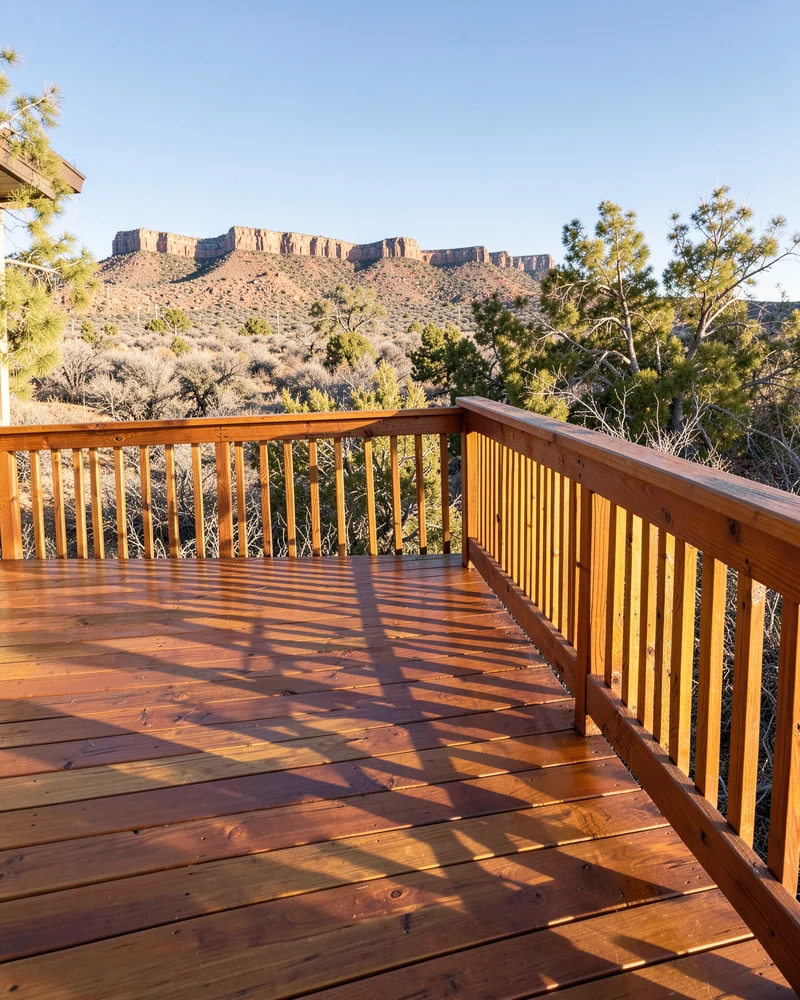
Late spring and early autumn are the reliable windows here. May into mid June, then September into early October. Midsummer is workable early in the day and on the shaded side. Late autumn is a gamble not worth taking, because the overnight lows arrive before the daytime highs stop looking ideal.
We watch overnight lows rather than daytime highs, and we would rather move a booking by two weeks than stain a deck into a bad window and have it fail inside a year.
How to tell if your deck is ready this year
Two quick checks before you arrange anything.
The water test tells you whether the timber will accept stain. Sprinkle water on several boards in different spots, including one in shade. Beading means the old finish is still sealing the wood, so you are recoating rather than restaining, and it may need stripping or sanding first. Soaking in within seconds means the timber is open and ready.
The board test tells you whether staining is worth doing at all. Press a screwdriver into a few boards, particularly at the ends and around the fixings where water collects. If it sinks in easily, that board is rotting and no amount of stain will fix it. Replace before you coat, and let new timber weather for a few weeks before staining so the mill glaze opens up.
Why stain and not paint
Worth saying, because people ask.
Paint forms a film on top of the timber. On a horizontal walking surface, water gets underneath that film through the end grain and around the fixings, and then foot traffic lifts it. Stain penetrates instead, so it wears gradually rather than peeling, and recoating is a clean and reapply rather than a strip back to bare wood.
Expect two to three years from a semi-transparent stain on a fully exposed deck here, and three to five from a solid stain. Rails and vertical faces last longer than the walking surface, because water runs off them.
See deck staining.