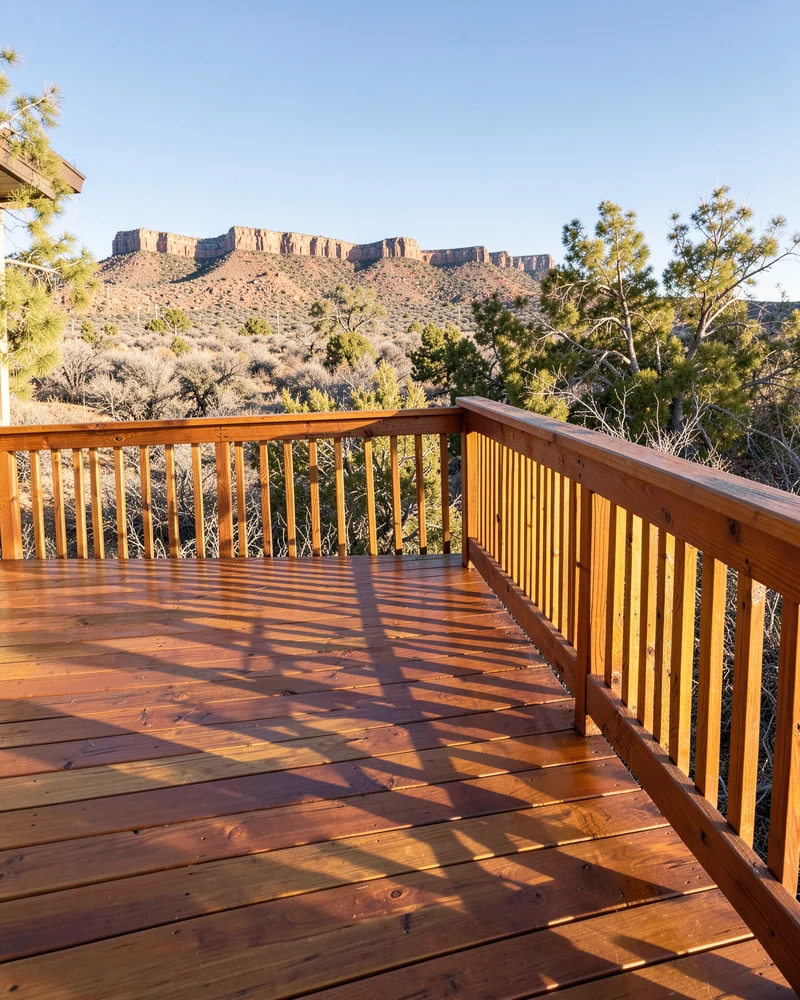
Deck staining cost in Grand Junction is priced on area, detail and the condition of the timber, and that last part is usually what separates two quotes on decks of the same size. A flat rate per square foot cannot account for forty spindles versus a cable rail, or a sound finish versus one that needs stripping.
We do not publish a flat rate, because the same 300 square foot deck can be two very different jobs depending on what is actually on it. Seven things decide where yours lands.
What this usually costs
Published national figures for deck staining, by deck size.
| National average | $850 |
| Typical range | $550 to $1,250 |
| 10 ft by 10 ft deck | $200 to $400 |
| 12 ft by 16 ft deck | $375 to $775 |
| 16 ft by 24 ft deck | $775 to $1,550 |
| Labour only | $1 to $2.50 per sq ft |
| Railings | $4 to $12.50 per linear foot |
Railings are why two decks of the same square footage can price very differently. A post and rail run carries far more surface area per foot than a solid panel, and every spindle is hand work.
Source: HomeAdvisor deck staining cost data, updated June 2026.
These are national market figures, not our price. We do not quote from a chart. Your estimate is written after we look at the actual surfaces, because condition and prep move the number more than square footage does.
1. Deck area
The flat surface is the base measure, walked and measured on site rather than taken from a listing. Multi-level decks are measured level by level, since each level needs its own staging and drying time.
2. Railing and spindle count
Detail carries a lot of the labour on a deck. Two decks of the same square footage can price very differently if one has forty spindles and the other has a cable rail or a solid skirt panel. Each spindle is four sides, hand brushed, and that adds up fast on a long run of railing.
3. Steps and skirting
Both are slow, hand-brushed work. Stair treads, risers and stringers all take stain differently, and skirting boards close to grade often need more prep because they hold moisture and dirt longer than the open deck surface.
4. Condition of the existing finish
Cleaning and recoating a sound, evenly worn stain is a fraction of the cost of stripping a failing one. If the old finish is peeling, graying unevenly, or was a solid-color product that is now chipping, that is a different job than a deck that just needs a fresh coat over a stain that wore down evenly.
5. Stripping
Chemical stripping and neutralising a peeling or failed stain can add a day or two to the timeline. Skipping this step over a failing finish is how a new coat ends up flaking off within a season, so where it is needed it goes on the estimate as its own line rather than getting skipped to hit a lower number.
6. Board repairs
Split, cupped or rotted boards are replaced before staining, priced separately from the staining itself. Staining over a board that is already failing structurally does not fix the board, and it wastes the coating.
7. Species
Cedar, redwood, pressure-treated pine and hardwoods all absorb stain differently, and a dense hardwood decking product can take more coats to reach an even, saturated finish than a softer pressure-treated board.
Why timing affects the job, not just the price
Stain works by penetrating the timber, and anything that stops it penetrating stops it working, regardless of how much was spent on the product. Freshly washed or recently rained-on decking needs to dry down before staining, days rather than hours depending on conditions. Direct summer sun in this valley can put a deck surface well above air temperature, and stain applied to a hot board flashes off before it can penetrate, leaving a blotchy finish. Most stains also have a minimum cure temperature, and autumn staining catches people out here because the afternoon feels fine and the overnight low does not. None of this changes the price on its own, but a job scheduled around the right window is a job that does not need redoing in two years.
What this means for your estimate
Work through the seven factors above against your own deck and you will have a rough sense of where it sits before anyone arrives. The exact number goes in writing once we have walked the deck and checked the existing finish up close. Your estimate is free, itemised, and states the prep, the product and the coat count before you commit to anything.
See deck staining for how we plan around the temperature and moisture window here, or the painting cost guide for what moves a number across every service we offer.