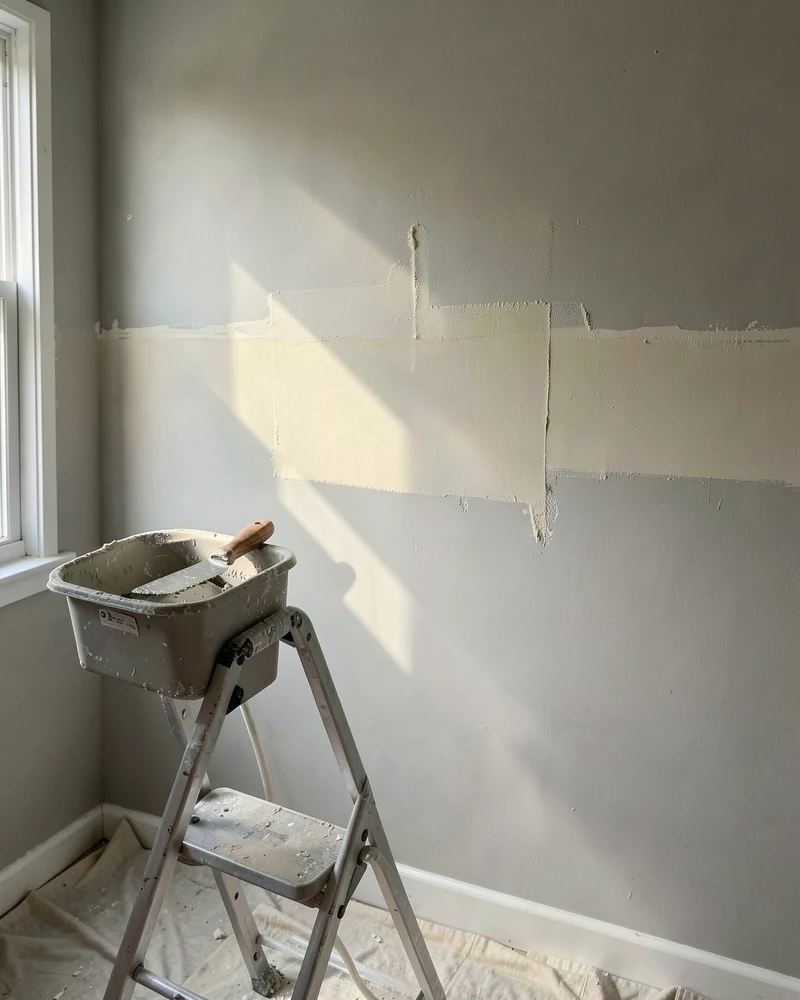
Drywall repair cost in Grand Junction is priced by the number and size of repairs and by how complex the texture is to match, rather than by room. Twenty nail pops scattered across a wall is a genuinely different job from one four-foot section of damaged board, even in the same size room.
Six things decide where your repair lands.
What this usually costs
Published national figures for drywall repair. Two credible sources disagree here, and the reason is worth understanding.
| Small holes, under 4 inches | $300 to $500 |
| Large holes | $500 to $800 and up |
| Cracks | $350 to $1,000 and up |
| Ceiling repairs | $350 to $1,500 and up |
| Minimum job fee | $350 to $650 |
| Texture matching | adds $125 and up |
HomeAdvisor prices the patch on its own. HomeGuide prices a tradesman driving out, setting up, and meeting a minimum call-out. Both are correct. It is the reason a single small hole rarely costs what a materials list suggests, and why several repairs booked together cost far less each than one on its own.
Sources: HomeGuide drywall repair cost data, October 2025. HomeAdvisor, updated June 2026, puts the national average at $612 with a typical range of $296 to $928.
These are national market figures, not our price. We do not quote from a chart. Your estimate is written after we look at the actual surfaces, because condition and prep move the number more than square footage does.
1. Number and size of repairs
Counted individually rather than averaged by room, since a handful of nail pops and a single large patch take very different amounts of time even when the wall area is similar.
2. Depth
A surface dent is one coat of compound. A hole through to the cavity needs new board cut in, taping, and three coats of compound with drying time between each one.
3. Texture
Smooth walls are the quickest to match. A heavy knockdown or a hand-applied skip trowel takes test boards and a longer match before the repair blends into the surrounding wall rather than reading as a patch.
4. Ceilings
Overhead work is slower than a wall repair at the same size, and popcorn ceilings need particular care to avoid disturbing the surrounding texture while patching.
5. Access
Stairwells and vaulted walls need staging to reach safely, which adds setup time beyond the repair itself.
6. Water damage
Depends on how far the moisture travelled and whether insulation or framing behind the board is affected. A stain that looks small on the surface can mean a wider repair once the board comes off.
Texture matching
Texture is what decides whether a repair reads as part of the wall or as a patch. Orange peel, knockdown, skip trowel and smooth finishes all get matched by hand, mixed and thinned to match the surrounding wall, and tested on a scrap board before touching the ceiling or wall itself. Older Grand Junction homes carry a wider mix of hand-applied textures than newer builds, so a repair on an older home often takes more time to match than the same size repair on a home built in the last decade.
How a repair actually gets done
A small dent or nail pop is filled with joint compound, sanded once it is dry, and primed before paint. A hole through the board is cut back to a clean edge, a new piece of board is set in and taped, and compound goes on in progressively wider coats, usually three, with drying time between each one. Priming the repair before paint matters more than it looks like it should: an unprimed patch absorbs paint differently to the surrounding wall and shows through the finish coat as a flat, dull patch even after two coats of paint, sometimes called flashing.
Common questions
Will the patch show? Not when it is feathered wide, textured to match and primed before the finish coat. Those three steps are what make a repair disappear into the wall.
How long does it take? Compound needs drying time between coats, so most repairs run two to three days before paint. Our dry air helps, but setting compound still needs its full window regardless of the climate.
How much dust will there be? Sanding makes fine dust, so doorways are sealed, floors are covered, and we vacuum as we go. On larger jobs we use vacuum-assisted sanding where the compound allows.
Why this is usually quoted with painting
Drywall repair is usually quoted alongside the painting rather than as a separate job, because in practice they are one piece of work: the repair has to be finished before the paint goes on, and the paint is what shows whether the texture match was right.
See drywall repair for our full process, or the painting cost guide for how repair work fits into an interior estimate. Whether it is a handful of nail pops before a repaint or a full resurface after years of patching, the estimate covers the repair and the paint together so you see one written number rather than two separate quotes to compare.