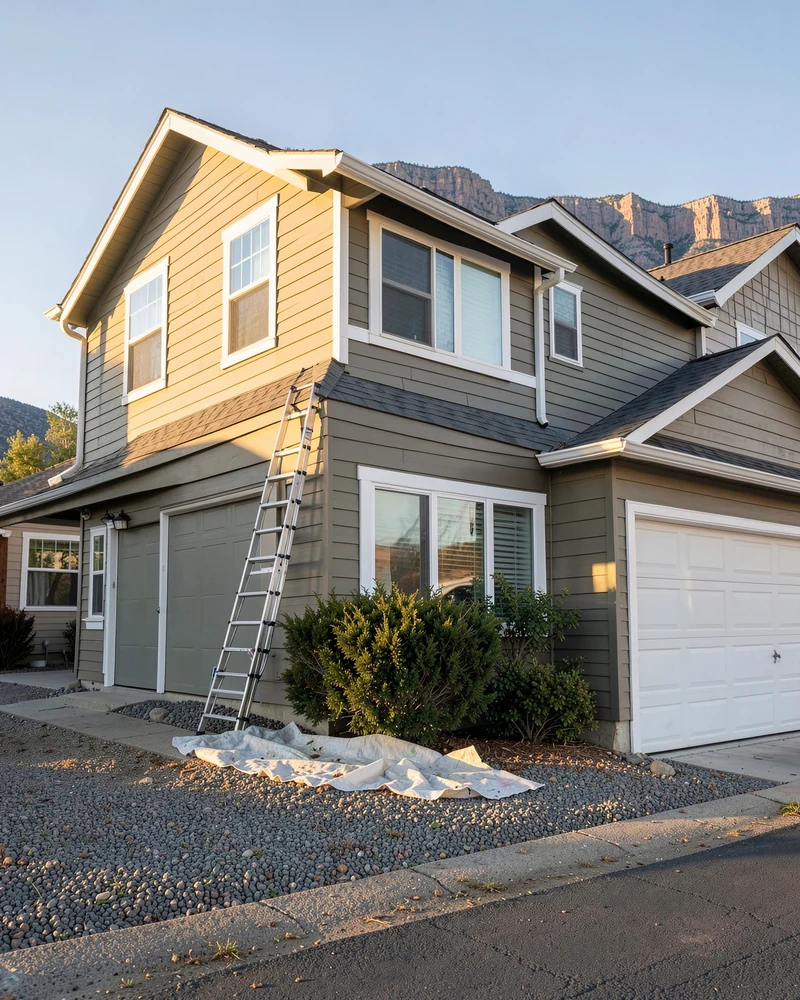
The best exterior paint for Colorado homes is not the same as the best exterior paint nationally, because the conditions that break a coating down here are not the average conditions the label was written for.
Altitude, UV load and daily temperature swing are the three things that separate products on the Western Slope. These are the five properties that decide how long a coating lasts, what to look for on the data sheet, and what we specify where.
1. UV resistance
The defining factor at this elevation.
Thinner atmosphere filters less ultraviolet, so at our UV index a wall takes more UV energy per hour of sun than the same wall at sea level. UV breaks down the binder holding the pigment together, and loose pigment on the surface is what chalking is.
What to look for: a 100% acrylic formulation, stated as such on the data sheet. Acrylic binders hold up under UV substantially better than vinyl-acrylic blends, which show up more often in lower-cost lines. Where we use it: everywhere, as the baseline on siding and trim.
2. Elasticity through freeze-thaw
The property most people have never had explained to them, and the one behind most joint failure here.
A daily swing of forty to fifty degrees means the substrate expands and contracts every single day of the year. A brittle film cracks where two materials meet, water gets in behind it, and the failure spreads outward from that line.
What to look for: elongation, quoted as a percentage on the data sheet. Anything describing flexibility or crack bridging is talking about the same property. Elastomeric coatings take it furthest, with elongation in the hundreds of percent. Where we use it: elastomeric on stucco specifically, and a flexible 100% acrylic on siding and at every caulked joint.
3. Breathability, on stucco especially
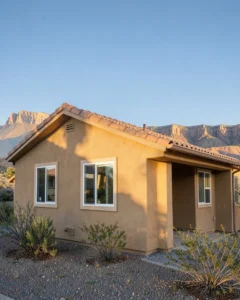
Stucco and masonry have to release moisture through the wall face, because there is nowhere else for it to go.
Seal them with a tight, non-breathable exterior paint and moisture builds behind the film and eventually pushes the coating off in sheets. We see this failure regularly across the valley, and it is entirely avoidable.
What to look for: a breathable masonry or elastomeric system with a stated perm rating, rather than general house paint. Higher perm means more moisture can pass through. Where we use it: every stucco elevation, and on masonry and block.
4. Adhesion over chalked surfaces
Most repaints here go onto a surface that has already chalked to some degree, because that is what our UV does to a coating at end of life.
Washing removes most of it. A bonding primer handles the rest. What does not work is asking a finish coat to grip a powdery surface, and that is the most common cause of sheet peeling on a repaint.
What to look for: a purpose-made bonding primer, chosen for the surface it has to stick to, rather than a self-priming claim on the finish coat. Where we use it: any wall that still shows chalk after washing, plus bare wood, glossy existing finishes, and tannin-rich timber like cedar and redwood, which need a blocking primer instead.
5. Colour retention
Deep, saturated colours have more pigment to lose and fade faster under this UV load. That does not rule them out. It means choosing a line with better stated colour retention if you want a dark exterior, and expecting the south wall to shift before the north one.
Dark colours also absorb more heat, which increases the daily expansion on that wall, which brings you back to elasticity. The properties interact, which is why the product is chosen per elevation rather than once for the whole house.
What about paint-and-primer-in-one
Worth addressing, because it is on the front of most tins now and it causes real confusion.
Self-priming products are genuinely useful on sound, clean, previously painted surfaces where you are recoating like for like. They are thicker-bodied finish paints, and on that job they perform well.
They are not a substitute for a real primer on bare wood, on chalked surfaces, on tannin-rich timber like cedar or redwood, or over a glossy existing finish. Those situations need a primer formulated for the specific problem: blocking tannin, bonding to a slick surface, or sealing porous material. Treating the claim as universal is the most expensive mistake we see on repaints here.
What we use as the best exterior paint for Colorado
Sherwin-Williams and Benjamin Moore exterior lines, specified per substrate and per elevation rather than one product across the whole house.
In practice that means a 100% acrylic exterior on siding and trim, a breathable masonry or elastomeric system on stucco, a direct-to-metal product over a rust-inhibitive primer on metal, and a bonding primer wherever we find chalking after washing. South and west elevations frequently justify a step up in grade, and we say so at the estimate rather than after.
Your estimate names the product line and sheen for each surface in writing, along with the coat count and the nine-year workmanship guarantee. If you want the reasoning behind any of it, ask at the walkthrough of your own house, where the answers are specific rather than general.
See exterior painting or stucco repair.