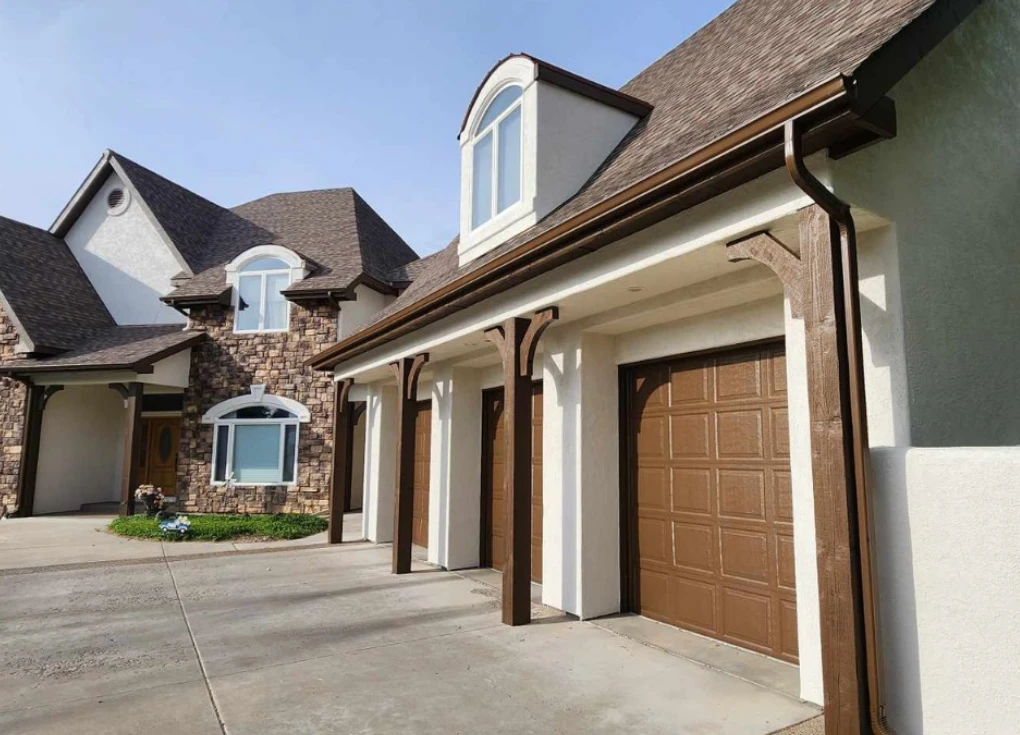
Exterior painting cost varies more between houses than any other painting job, and the reason is rarely the size of the house. Two homes on the same street with the same footprint can price thousands apart for entirely legitimate reasons.
Two houses with the same floor plan can be a long way apart, and the gap is almost always condition and access rather than anything else. A single-storey home with a coating that is simply tired is the lower end of the range. The same home in two storeys, with widespread scraping, bare wood and caulk replacement, sits far above it, because prep hours climb and everything above the first storey needs staging. Facade area is measured elevation by elevation, not taken from the floor area.
Six things move where you land.
What this usually costs
Published national figures for exterior painting, by height and by siding type.
| Single storey | $1,500 to $3,500 |
| Two storey | $3,000 to $6,200 |
| Three storey | $4,500 to $10,000 and up |
| National average project | $3,177 |
| Wood siding | $1 to $3 per sq ft |
| Fiber cement | $1.20 to $3.20 per sq ft |
| Stucco | $1.50 to $4 per sq ft |
| Brick | $1.50 to $4.50 per sq ft |
Sources do not agree on taller homes. This Old House, in March 2026, puts a two storey 2,000 sq ft house at $6,900 to $12,700, well above the figure above. Access is the reason: once ladders become staging, labour hours climb fast.
Source: HomeAdvisor exterior painting cost data, updated June 2026.
These are national market figures, not our price. We do not quote from a chart. Your estimate is written after we look at the actual surfaces, because condition and prep move the number more than square footage does.
1. Facade area and storey count
Wall area drives materials. Storey count drives access, and access drives labour.
A single-storey home can largely be painted from the ground and a 6 foot ladder. A two or three-storey elevation needs staging or extension ladders, set up and repositioned repeatedly, with a spotter and tie-offs. The second storey of a house costs meaningfully more per square foot than the first, every time, and a third storey more again.
2. Substrate type
Wood siding, fibre cement, stucco, brick and metal all behave differently and all want different products.
Wood needs the most attention, because it moves with humidity, it splits at the ends, and previously painted timber is usually where the failures start. Stucco needs a breathable coating rather than a tight film, and sealing it with the wrong product traps moisture that pushes the coating off in sheets within a couple of years. Fibre cement is the most stable and generally the most straightforward. Metal depends almost entirely on whether corrosion is dealt with before coating, which means a rust-inhibitive primer, not more topcoat.
3. Condition of the existing coating
The single biggest swing factor on any exterior.
A house whose last repaint was done properly and is simply looking tired needs washing, spot priming and recoating. A house that is peeling, blistering or chalked to powder needs scraping, feathering and priming across large areas before any finish coat goes on, and that is where the hours go.
Two field checks you can do this afternoon. Rub your hand along a south-facing wall: if it comes away powdery, that is chalking, and that wall needs washing and most likely a bonding primer. Then press the blade of a putty knife under a lifting edge: if paint comes away in sheets down to bare wood, you are looking at area prep rather than spot prep, and the number moves accordingly.
4. How much prep the failure creates
Related to the last point, but worth separating, because prep is the largest single labour line on a failing exterior.
Scraping, sanding, feathering the edges so the repair does not telegraph, treating bare wood within days so it does not weather again, cutting out and replacing failed caulk at every window and door surround, and priming everything exposed. On a badly failed house that can be 50 to 70 percent of the total hours. None of it is visible in the finished result, which is exactly why it is worth having written down.
Our estimates itemise prep as its own line, with the surfaces and the products named, so you can see what share of the price it is.
5. The coating system specified
In Grand Junction this matters more than in most of the country. High UV and daily temperature swings of forty to fifty degrees put real stress on the film.
A better exterior acrylic costs roughly $25 to $40 more per gallon and buys years of extra life, particularly on south and west elevations. A lower-grade coating over a properly prepped wall can still start chalking inside twenty-four months here. You can look up the local UV index and see why. On stucco the right answer is a breathable masonry or elastomeric system with a stated perm rating, and on siding it is a 100% acrylic rather than a vinyl-acrylic blend.
6. Access and site conditions
Steep ground, tight side returns, mature landscaping planted hard against the walls, pools, solar panels, and anything that has to be protected or worked around all add time.
None of it is dramatic on its own. Together it is often a day or more on a larger property, and it is better priced at the estimate than discovered in week two.
What a painting quote is actually made of
A quote is five things bundled into one number. Once you can see the five, two quotes become easy to compare on substance rather than on the total at the bottom.
- The prep specification. Which surfaces get washed, scraped, sanded, feathered and primed, and whether caulk is being replaced or only topped up. This is the biggest line, so it deserves the most detail.
- Coat count per surface. Body, trim, fascia, soffits, doors and any metal, each stated separately. One coat on a colour change and two coats are different jobs.
- The products by name and grade. Manufacturer, product line and sheen, per substrate. “Premium exterior paint” is not a specification. “Sherwin-Williams or Benjamin Moore 100% acrylic on siding, breathable masonry system on stucco” is.
- Warranty length and what it covers. Ours is nine years in writing on workmanship, issued with your paperwork at completion.
- Who does the work. Whether the people on site are employees of the company you signed with, and whether the same crew stays on the job start to finish. Ours are, and they do.
Put two quotes side by side on those five points and any difference in price usually explains itself. If a line is missing from either quote, including ours, ask for it in writing.
Getting an exterior painting cost you can trust
We walk the whole exterior before we price it, elevation by elevation, because chalking, bare wood and failed caulk are things you have to see and touch. Your estimate is free, itemised, and written with the nine-year workmanship guarantee on it, and there is no deposit at any stage. You pay after the final walkthrough, once you have approved the work.
That walk is also where we tell you which elevations need a step up in coating grade, which is a large part of what a realistic figure is buying you here.
See exterior painting or the painting cost guide.