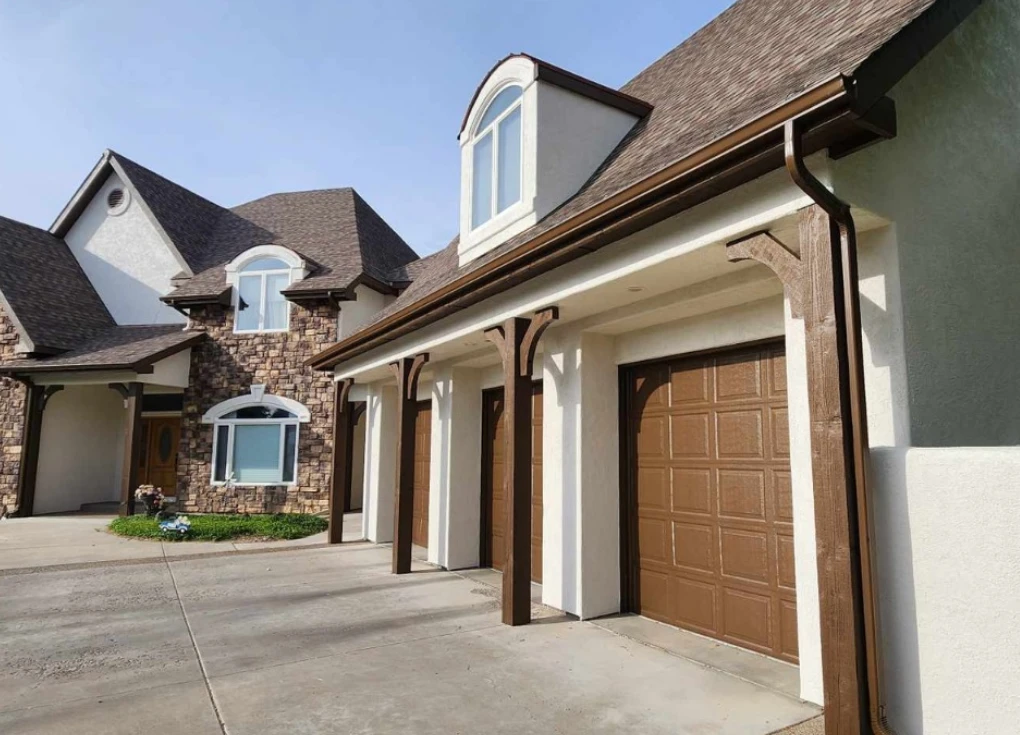
How long does exterior paint last is a question with a national answer and a local answer, and in Grand Junction they are not the same. The label on the tin was written for average conditions. This valley sits at 4,600 feet with high UV, very dry air and a daily temperature swing of forty to fifty degrees, and a lower-grade coating over light preparation can start chalking inside twenty-four months here.
Five factors decide what you actually get.
1. Preparation standard
The largest factor by a wide margin, and the part of the job that stops being visible the moment it is finished.
Our crews prepare to Painting Contractors Association standards: wash, scrape, sand, feather the edges, treat bare wood, replace failed caulk, and prime everything exposed. Paint bonded to clean, sound, primed material lasts. Paint applied over dust, chalk, damp or a failing previous coating is bonded to something that is itself letting go. The coating can only hold on as well as the layer beneath it.
This is why two houses painted the same week with the same product can be five years apart in outcome, and it is why we itemise prep as its own line on the estimate.
2. Coating grade
Better exterior acrylics hold colour longer, stay flexible longer, and resist UV breakdown longer. The premium is roughly $25 to $40 a gallon and in this climate it pays back.
Two properties matter most here. UV resistance, which comes from a 100% acrylic binder rather than a vinyl-acrylic blend. And elasticity, which is worth understanding because it is what lets a coating stretch with a substrate that expands and contracts every single day. On a product data sheet it appears as elongation, quoted as a percentage. Higher is better on anything that moves, and it is the difference between a film that flexes at a siding joint and one that cracks there.
3. Elevation and exposure
Your house does not weather as one object.
South and west elevations take direct high-altitude sun for hours daily and will always fail first, typically at six to eight years. North faces get far less UV but stay damp longer after snow and can grow mildew. East is generally the easiest and often reaches the top of the range.
Expect the exposed faces to need attention years before the sheltered ones. That is normal, and it is why we price elevations separately and specify a step up in grade on the south and west rather than averaging one product across the whole house.
4. Substrate
Wood moves with humidity, splits at the ends, and needs the most maintenance. Stucco needs a breathable coating with a stated perm rating and will fail dramatically if sealed with the wrong product. Fibre cement is stable and generally the longest-lived, with factory-primed board doing best. Metal depends almost entirely on whether corrosion was dealt with, which means a rust-inhibitive primer rather than extra topcoat.
The substrate sets the ceiling on how long any coating can last on it. No paint outperforms the material it is sitting on.
5. Film thickness
Two proper coats meaningfully outlast one heavy pass, even when the wet volume applied looks similar.
Film thickness is what provides UV protection and water resistance. Most exterior acrylics want roughly 4 mils wet per coat, which dries to about 1.5 mils, so two coats gives you around 3 mils of dry film. Thin coverage looks perfectly fine on day one, which is exactly the problem, because you cannot tell by eye whether you got two real coats or one stretched one. That is why coat count per surface belongs in writing on the quote.
What you can do to extend it
Three things, none of them expensive.
Wash the exterior once a year, particularly the elevations facing the prevailing wind and the dust. Grime holds moisture against the film and accelerates breakdown. A garden hose and a soft car brush is enough for most houses, working bottom to top and rinsing top to bottom.
Keep caulk maintained. Caulk fails long before paint does, and replacing a failed bead at a window surround costs almost nothing compared with repairing the wall after two winters of water getting in behind it.
Trim vegetation back to at least a foot off the walls. Shrubs pressed against siding hold moisture, block drying, and abrade the coating every time the wind blows. While you are there, check that sprinkler heads are not throwing water onto the siding, which is a common cause of blistering on one wall of an otherwise healthy house.
So how long does exterior paint last in Grand Junction
Properly prepped, good coating, correctly applied: eight to twelve years on most elevations, with south and west faces at six to eight.
Lightly prepped, lower-grade coating: two to four years, and often less on an exposed wall.
Our workmanship guarantee runs nine years in writing, which is a deliberate position on where in that range a properly done job should sit. It is issued with your paperwork at completion, and there is no deposit at any point before it.
See exterior painting and how often to repaint.