How much does it cost to paint a room is the first thing most people want settled, and it comes down to six things you can measure for yourself before anybody arrives with a clipboard.
We do not publish a per-room figure, and there is a reason for that rather than an evasion. The same 12 by 12 bedroom can differ by a factor of three on surface condition alone, so any number printed here would be wrong for most of the people reading it.
What is stable is the shape of the job. A bedroom with sound walls, walls only, two coats, is the smallest version. Adding the ceiling adds roughly a third again in paintable area at a standard eight foot height. Adding trim, a closet and two doors adds hours rather than area, because cut-in is the slowest work in any room. A vaulted great room is the largest version on both counts, surface and the staging needed to reach it.
Six factors decide where your room lands.
What this usually costs
Published national figures for interior painting, so you have something to measure a quote against.
| Bedroom, about 120 sq ft | $240 to $720 |
| Living room, about 330 sq ft | $700 to $2,000 |
| Bathroom, about 70 sq ft | $140 to $420 |
| Walls only | about $2.75 per sq ft |
| Walls, trim and ceilings | about $4.70 per sq ft |
| Whole interior, typical | $965 to $3,089 |
The jump from $2.75 to $4.70 per square foot is the difference between painting walls and painting walls, trim and ceilings. It is the single biggest reason two quotes on the same house can look nothing alike.
Source: HomeAdvisor interior painting cost data, updated June 2026.
These are national market figures, not our price. We do not quote from a chart. Your estimate is written after we look at the actual surfaces, because condition and prep move the number more than square footage does.
1. Wall area, not floor area
Houses are described in floor area. Paint is priced on wall area, because the wall is the surface being coated.
Measure the perimeter of the room and multiply it by the wall height. A 12 by 12 bedroom is 48 feet of perimeter, so at an 8 foot ceiling that is 384 square feet of wall. Subtract about 20 square feet per door and 15 per average window. Now take a long narrow 8 by 18 room. Same 144 square feet of floor, but 52 feet of perimeter and about 416 square feet of wall. Identical on a floor plan, more paint and more cutting in.
That is why interior work is measured and priced on wall and ceiling area rather than on the floor area an estate agent would quote you.
2. Ceiling height
Eight feet is the standard here, and a lot of newer construction runs 9 or 10. Anything above that changes the method, not only the area.
Once a wall is taller than a person can reach comfortably from the floor, the work needs ladders or staging, set up, moved and reset for every section. Cutting a straight line where wall meets ceiling takes roughly twice as long at 16 feet as it does at 8, because you are working from a platform and repositioning constantly. A two-storey entry or a vaulted great room commonly carries 25 to 40 percent more labour than its square footage suggests.
3. Surface condition
The biggest variable on any interior, and the one that explains most of the difference between two quotes on the same room.
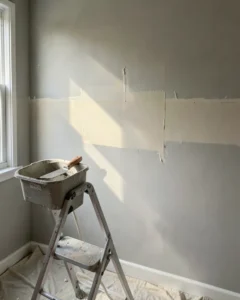
Sound, previously painted walls in good condition need a wash, a few filled nail holes, and fresh caulk where the trim meets the wall. That is an hour or two of prep. Walls with nail pops, settlement cracks, old patches that were never textured, water staining or drywall damage need filling, sanding, texture matching and spot priming. That is measured in hours per wall rather than minutes per room, and heavy repair can add a full day to a single bedroom.
Two specifics worth knowing before you compare numbers. Water marks, smoke and marker bleed through finish paint however many coats go over them, so they need a stain-blocking primer first. And a repair has to be textured back to match the wall around it, because a smooth patch inside an orange-peel wall reads as a flat spot under side light.
Paint does not hide any of this. It removes the colour variation that was disguising the texture difference, so a bad patch is more obvious after painting than it was before.
4. Paint grade
We work with Sherwin-Williams and Benjamin Moore, and our crews work to Painting Contractors Association standards.
Better wall paint costs roughly $20 to $35 more per gallon and hides in fewer coats, so part of the premium comes back as labour you did not have to pay for. The rest shows up in scrub resistance. A builder-grade flat burnishes to a shiny patch the first time somebody wipes a mark off it. A good 100% acrylic in eggshell takes repeated cleaning and still looks even after three years of a family living in the room.
Sheen matters as much as grade, and it is free to get right. Flat on ceilings, because any sheen on a ceiling shows every imperfection under downlights. Eggshell in hallways, kids’ rooms and anywhere that gets wiped. Satin or semi-gloss on trim and doors, in a waterborne enamel that levels out brush marks as it cures.
5. Number of coats
One coat is only ever enough when you are refreshing the same colour on a sound wall.
A colour change usually needs two. Dark to light often needs two over a tinted primer. Strong reds, deep blues and bright yellows can need three, because those pigments have poor hiding power on their own. Bare drywall needs primer plus two coats, every time.
Our dry air is relevant here. Surface dry happens fast in the valley, which is convenient, but the recoat window printed on the tin still applies. Rolling a second coat onto paint that has skinned over without curing is how you get lap marks that never level out. We plan the day around the recoat window rather than compressing it, and every quote we write states the coat count per surface, so you can see exactly what is included.
6. Trim, doors and detail
Cutting in is the slow part of any interior. A plain bedroom with one door and one window is fast. A room with the same wall area plus wainscoting, crown moulding, three windows, two doors and a built-in bookcase can take twice as long.
Trim normally takes a different product to the walls, which means a separate setup, separate masking and separate dry time. Doors are counted per side. A six-panel door has profiles that have to be coated evenly without pooling in the corners, and that is careful brush work rather than fast rolling.
So how much does it cost to paint a room in Grand Junction
Work through the six factors above for your own room: ceiling height, wall condition, coat count and trim. That gets you close enough to plan around.
The exact number goes in writing once we have walked the room. Your estimate is free and itemised room by room, and it includes a full hour with a colour designer. It states the prep, the coat count, the product and sheen per surface, and the nine-year written guarantee on workmanship. You pay nothing upfront and nothing at all until you have approved the finished work at the walkthrough. That is how we price a specific room in a specific house.
More detail on our painting cost guide, or see interior painting.