How often to paint house exterior surfaces is usually answered with a range, five to ten years, and that range is technically correct and practically useless. Your house does not care about the average. It cares about which direction its walls face and how well the last coat was applied.
Rather than counting years, look for these five signs. Any two of them together means it is time.
1. Chalking
Check the local UV index, then run your hand along a south or west-facing wall on a dry day. If it comes away with a fine powder on it, that is chalking.
It means the binder in the coating has broken down under UV and is releasing the pigment. Chalking is normal at end of life and it is the earliest reliable signal. It also matters practically: fresh paint will not bond to chalk. That wall will need washing and most likely a bonding primer, so catching it early keeps the next job simpler and cheaper. Light chalking that comes off on a damp cloth is early. Chalking that leaves a visible line on your sleeve is late.
2. Uneven fading, especially on one elevation
Look at the south and west walls next to the north wall. If the colour difference is obvious from the driveway, the sun has done meaningful damage.
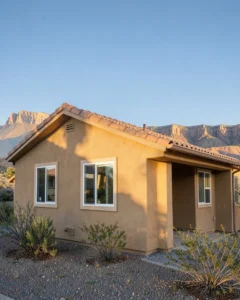
At 4,600 feet the atmosphere filters less ultraviolet, so an exposed wall here takes more UV energy per hour of sun than the same wall at sea level. Fading normally shows on the south and west two to four years before it shows anywhere else. That is entirely normal in this valley, and it is why we specify those walls differently rather than averaging one product across the house.
3. Hairline cracking at joints and seams
Look at the butt joints in siding, and at the corners of windows and doors, where two materials meet and move against each other.
Fine cracking there is the daily forty to fifty degree temperature swing working the material. Once the caulk has gone brittle and split, water has a route in, and water behind a coating does far more damage than the crack you can see. Cracks you can slide a fingernail into are past the point where a topcoat will bridge them.
4. Peeling, blistering or flaking
The obvious one, and by the time it appears the decision has usually made itself.
It is still worth reading what it tells you. Peeling in sheets normally means a bonding failure, paint applied over a surface that was dirty, chalked or damp. Blistering usually means moisture trapped behind the film, often from a sprinkler hitting the wall or a downspout discharging against it. Flaking on bare wood means the timber has been exposed long enough to weather, and weathered wood needs sanding back to sound fibre before primer. Each needs a different fix, and none is solved by another coat over the top.
5. Caulk failure
Go and look specifically at the caulk lines around your windows and doors, and where the siding meets trim.
Caulk has a shorter service life than paint, typically five to ten years for a standard acrylic latex bead and fifteen to twenty for a good urethane or hybrid, and in this climate it works harder than almost anywhere because it is stretching and relaxing every day. Split, shrunken or missing caulk is the most common way water gets into a wall. It is cheap to cut out and replace now, and expensive once the sheathing behind it has been wet through two winters.
Check twice a year, not once a decade
You do not need to inspect your house monthly. Twice a year is plenty, and the timing matters more than the frequency.
Look at the end of winter, once the freeze-thaw cycles have finished working the joints. That is when caulk splits and hairline cracking show up most clearly. Then look again at the end of summer, after the walls have taken a full season of UV, which is when chalking and fading are easiest to see.
Ten minutes each time, walking the perimeter with the low sun behind you so the light rakes across the surfaces. Side light shows texture and failure that flat midday light hides completely. Take a photo of the same three spots each time, because year-on-year comparison tells you more than any single look.
So how often to paint house exterior surfaces here
Properly prepped, with a good 100% acrylic, eight to twelve years on most elevations in this valley. South and west faces sit at the shorter end, often six to eight. A lower-grade coating over light preparation can start failing inside twenty-four months, which is where the low end of every published range comes from.
Two things stretch the interval without costing much. Wash the exterior once a year, and keep the caulk maintained. Both are covered in more detail in the maintenance section of the guide below.
Our workmanship guarantee runs nine years in writing, which is a deliberate statement about what proper preparation should buy you.